
Allure: Alpha Werewolf Stories
Riseforward Ltd.Books & Reference
4.867.00 Reviews
- Version
- 1.15.5
- Installs
- 10.00K
- Age Rating
- Teen
Screenshots

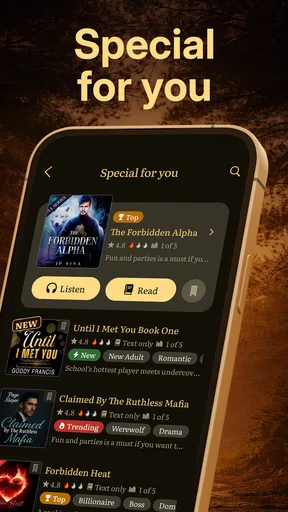
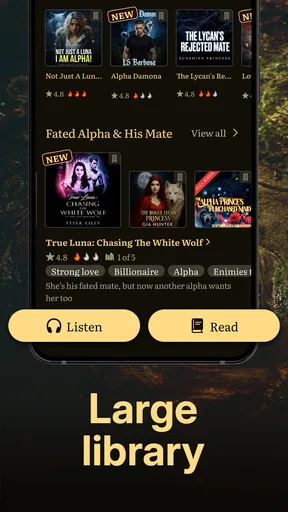
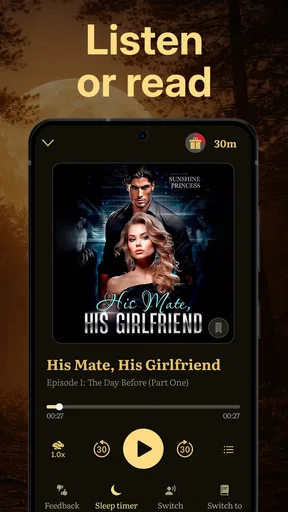

Our Review of Allure: Alpha Werewolf Stories
 Analysis by Appyee
I approached Allure: Alpha Werewolf Stories as a reading app for a very specific mood: dramatic romance, supernatural tension, and stories designed to be heard rather than simply skimmed. It sits in the Books & Reference category, but it feels closer to an audio fiction lounge than to a traditional digital library. The focus is on romance audiobooks and werewolf-themed love stories, with passion and conflict at the center.
That narrow focus is both its strongest quality and its biggest limitation. If you already enjoy forbidden romance, alpha-werewolf plots, and serialized storytelling, the app gives you a direct route into that world. If you are looking for general audiobooks, literary fiction, reference material, or a broad reading service, I would not choose it as my main app. I found it most appealing when I wanted something atmospheric and easy to follow while doing routine tasks.
How Allure fits into a shared household
When a device is shared, I think the most helpful starting point is deciding whether Allure is one person’s private listening app or something adults plan to enjoy together. That small choice shapes where the app sits on the device and how comfortably others can use it. From there, everyday listening habits can keep the story immersive without making it an awkward surprise for someone else.
A realistic evening use case
Imagine a shared tablet in a household: one person uses it for music and podcasts, another wants a romantic story before bed, and someone else may pick it up the next morning. In that situation, Allure can work well as a personal listening choice, but I would not treat it as a neutral family reading app. Its content is built around intense romance and supernatural relationships, so the household needs a clear understanding of who is using it and what kind of material is appropriate.
My preferred use case would be an adult or older teen listening with headphones while commuting, folding laundry, cooking, or relaxing alone. Audio makes the format convenient because I do not need to keep looking at the screen. That convenience also makes it easy to forget what is playing when a shared device is left unattended, so I would finish or pause a chapter before handing the device to somebody else.
The app’s store summary makes its identity clear: this is about romance audiobooks and forbidden werewolf love, not a general-purpose collection of nonfiction or classic novels. I appreciate that focus because it avoids making me search through unrelated categories. At the same time, it means the experience depends heavily on whether that particular fantasy-romance style matches my mood.
Why shared-device use needs a little planning
On a personal phone, the listening experience feels straightforward. On a family tablet, the main challenge is not navigation but context. A story paused in the middle of an emotionally charged scene can be awkward if another person opens the app without knowing what it contains. I would keep this app inside the user profile of the person who actually listens to it, when the device supports separate profiles, rather than placing it in a common entertainment folder.
That is also useful for continuity. A shared device can easily mix one listener’s place with another person’s browsing, especially when the same app is opened casually. I recommend agreeing on one simple household rule: the person using Allure should pause the story, close the app, and return the device to its usual place afterward. It sounds minor, but it prevents accidental exposure and avoids confusion about where a chapter was left.
For a couple or two adults sharing a device, the situation is different. The app can become a convenient way to discover a dramatic story together, especially if one person listens aloud while the other follows along with household chores. Still, I would not assume that both listeners want the same level of romantic intensity. The best arrangement is to sample the tone together before making it part of a shared routine.
Keeping accounts and purchases separate
Allure is free to install, which lowers the barrier to trying it. The app also includes in-app purchases ranging from $4.99 to $519.99 per item, so I would pay attention whenever the app presents an option to buy something. The wide range matters more on a shared device because a child, guest, or second household member could misunderstand which actions involve money.
I would use the device’s normal purchase protections and keep the store account tied to the intended buyer. I am not describing a special Allure family system here; rather, this is a sensible habit for any app with optional purchases. A shared tablet should never be left with an active payment flow open, and each household should decide who is allowed to approve purchases.
There is a useful trade-off here. Installing the app costs nothing, so a listener can judge the style before spending anything. But “free” should not be interpreted as “everything inside is free.” I would first learn how the story catalogue is organized, listen to enough of the available material to decide whether the narration and writing suit me, and only then consider spending money.
Setup, boundaries, and everyday listening
I find a little preparation especially useful when audio fiction becomes part of a daily routine: choose a listener, agree on headphones or shared playback, and settle purchase expectations before browsing. Those simple boundaries leave more room to enjoy a story during a commute or chore without turning setup into a household negotiation. They also make the app easier to hand back and forth responsibly.
What I would check before handing over the device
The app is developed by Riseforward Ltd. and has a Teen content rating. That rating is an important part of the setup conversation in a household. It tells me that the app should not be treated like a children’s story player, even if the interface itself looks approachable. The themes involve romance, passion, and forbidden relationships, so the age context should be discussed rather than ignored.
I would also check the device’s operating system before installing. Allure requires Android 8.0 or later, which covers many older Android devices but not every phone or tablet still in circulation. If the household uses an older spare device, compatibility is the first practical question. There is little value in planning a listening routine around an app that the chosen tablet cannot run properly.
The current version is 1.15.5. I see that as a useful sign for installation planning because the app is not being presented as an abandoned experiment. Still, I would update it before a long trip or before setting it up for someone else. A fresh installation reduces the chance of starting with an outdated build, and it gives the listener a clean opportunity to understand the current layout.
Boundaries that make the experience better
I found that Allure works best when I define what I want from it before opening it. If I am in the mood for a focused supernatural romance, I can settle in and let the audio carry the story. If I only have five spare minutes and want a quick factual answer, this is the wrong tool. The app rewards deliberate listening more than random browsing.
For shared use, I would set three boundaries. First, decide who the intended listener is. Second, agree whether the app is for private headphone listening or occasional shared listening. Third, make the purchase rule explicit. These are household arrangements, not special functions I would expect the app to provide, but they make a noticeable difference when several people use one device.
A practical workflow is to begin with headphones, listen during a low-risk task, and keep the phone locked when the story is paused. That lets me judge the narration without turning the room into an accidental listening session. It also avoids the common problem of starting an audio story in a public or family setting where the content may not fit the audience.
Audio convenience versus reading control
The central appeal is listening. Compared with a conventional ebook app, Allure is better suited to moments when my eyes and hands are occupied. I can follow a romantic plot while walking or doing repetitive chores, and the audio format gives the story a more immediate emotional rhythm than silent reading.
The compromise is control. When I read an ebook, I can scan backward, reread a paragraph, or slow down naturally at a complicated exchange. Audio asks me to follow the narrator’s pace. If I miss a name or relationship detail while washing dishes, I need to rewind and reconstruct the scene. For that reason, I prefer listening during familiar tasks rather than during work that requires concentration.
This is one of the app’s less obvious trade-offs: the most convenient moments for listening are also the moments when attention is divided. Werewolf romance often depends on shifting loyalties, hidden identities, and emotional tension. I get more from the story when I save it for a walk or routine task, not when I play it underneath a meeting, study session, or complicated recipe.
Using the app as a mood-specific library
I would not build my entire audiobook habit around Allure. I see it as a specialist shelf. A broad audiobook service is usually the better choice when I want biographies, history, science, language learning, or a wide mix of genres. Allure is more useful when I already know that I want supernatural romance and do not want to wade through unrelated recommendations.
That specialization can make choosing easier. Instead of asking what to read from an enormous catalogue, I can open the app with a clear expectation of emotional drama and fantasy romance. The downside is repetition if I use it too often without changing my listening habits. When every story is selected for a similar romantic atmosphere, the novelty may depend on the characters and plot rather than the overall genre.
My advice is to alternate it with a different kind of listening. I might use Allure for an evening story, then switch to nonfiction or a mystery elsewhere on another day. That keeps the app’s distinctive tone enjoyable instead of turning it into background noise.
Coordination, trust, and age context
For me, coordination is less about controlling another person’s listening and more about making expectations clear, particularly when a Teen-rated app is used around family members. A quick conversation about who the stories are for, when playback is appropriate, and who can approve purchases can prevent avoidable friction. With that groundwork in place, age context becomes a practical part of choosing how the app fits into the household.
How I would coordinate use among adults
For adults sharing Allure, coordination is mostly about expectations. One person may enjoy intense romantic conflict, while another may prefer lighter stories. Rather than assuming that a shared queue will please everyone, I would let each listener choose privately and use headphones unless both people have agreed to listen together.
If two people do listen together, I recommend stopping at natural chapter breaks instead of leaving the story running indefinitely. This makes it easier to remember what happened and prevents one person from taking over the other’s listening time. It also helps when the device is needed for navigation, calls, or another person’s activity.
A second useful habit is to say out loud when a story is paused. On a shared tablet, “I left it ready for you” can mean the app is open, the audio is stopped, and the device is safe to pass on. That small bit of communication avoids the confusion that comes from pressing play without knowing the scene or the volume level.
Teen rating and household trust
The Teen rating means I would place Allure in the same general conversation as other teen-oriented entertainment: accessible to younger audiences than adult-only material, but not automatically suitable for every child. The themes are romantic and passionate, and the werewolf premise brings fantasy danger and relationship drama into the stories. Parents and guardians should make the decision based on the individual listener’s maturity and the household’s standards.
I would not use the rating as a substitute for supervision or conversation. A teenager who is allowed to install the app should still understand that stories are fictional and that dramatic possessiveness, secrecy, or forbidden romance may be storytelling devices rather than healthy relationship models. That is especially relevant when a household shares content casually and nobody discusses what is being consumed.
Trust works better here than pretending the app is a generic children’s audiobook player. I would explain why the app is being allowed, establish whether purchases are permitted, and ask the listener to speak up if a story feels uncomfortable. Those boundaries are more realistic than assuming one rating can answer every family’s question.
When another app is the better choice
I would skip Allure if my main goal were educational listening, a large selection of unrelated genres, or a quiet bedtime story for a young child. A general audiobook platform is a better fit for a household that needs one service to cover many ages and interests. An ebook reader is also preferable if I want to annotate, search text, or control the pace line by line.
I would also hesitate if I dislike serialized romantic tension or supernatural relationship plots. The app’s identity is not a minor theme layered over a broad library; it is the reason to install it. Someone who wants realistic contemporary romance without werewolf elements may find the premise too narrow, while a listener seeking action without a strong romantic focus may feel that the emotional storyline dominates.
On the other hand, I would recommend trying it to a listener who repeatedly searches for alpha-werewolf fiction and wants an audio-first experience. The focused catalogue can save time compared with browsing a general service, and the free installation makes an initial trial less demanding. The important thing is to approach it as a genre destination, not as a replacement for every other reading app.
My household verdict after using it
Allure: Alpha Werewolf Stories is a focused Books & Reference app with a clear personality. I like that it does not disguise its subject: romance, passion, and forbidden werewolf relationships are the center of the experience. The audio format makes it practical during chores, walks, and quiet personal time, while the narrow theme helps me find the kind of fiction I want without searching a huge general catalogue.
Its household fit depends on thoughtful setup. Because the app carries a Teen rating and includes optional purchases, I would keep it associated with the intended listener, use headphones on shared devices, and establish a simple rule about spending. I would not present it as a universal family app, and I would avoid leaving it playing openly in a room where younger children or guests may be listening.
The app has attracted an average rating of 4.8 from around 444 ratings, with about 67 written reviews, and it has passed 10K+ installs. Those figures suggest that the concept is connecting with a real audience, although numbers alone cannot tell me whether a particular narrator or story will match my taste. I treat them as encouragement to try the app, not as a guarantee that every title will work for me.
Since it is free to install, my recommendation is to test the experience before considering any optional purchase. Listen in a quiet, familiar situation, notice whether the narration holds your attention, and decide whether the werewolf-romance focus feels exciting or repetitive. That short trial tells you more than the genre label alone.
My final view is positive but specific: I would recommend Allure to a teen or adult listener who already enjoys supernatural romance and wants stories delivered through audio. I would not recommend it as the only reading app in a shared household, nor as a children’s entertainment choice. Used with clear age expectations, separate account habits, and sensible purchase boundaries, it can be an enjoyable private escape. Its real strength is focus, and its real weakness is that the same focus leaves little room for listeners who want a broader library.
Verdict
Strengths of Allure: Alpha Werewolf Stories
- Immersive werewolf-themed stories with strong romantic tension.
- Choice-based gameplay lets readers influence relationships and plot outcomes.
- Attractive character art supports the supernatural atmosphere.
- Regular story progression provides new scenes to keep readers engaged.
- Easy to start, with an interface suited to casual reading sessions.
Limitations of Allure: Alpha Werewolf Stories
- Some choices may require premium currency or paid purchases.
- Story pacing can feel slow when waiting for energy or chapter access.
- Romance-focused content may not appeal to players seeking action gameplay.
- Different endings may require replaying chapters and repeating scenes.
- Performance and loading times can vary on older mobile devices.
Other Releases by Riseforward Ltd.
View All
Amora: Romance Novels & Books
Books & Reference4.3

MyLuna: Werewolf Romance Books
Books & Reference4.6
Similar Picks in This Category
View All
Google Play Books & Audiobooks
Google LLC4.7

네이버 - NAVER
NAVER Corp.3.5

Wattpad - Read & Write Stories
Wattpad.com3.7

King James Bible - Verse+Audio
Ozion4.8

Bible Offline-KJV Holy Bible
Bíblia Offline4.9

Amazon Kindle: Reading App
Amazon Mobile LLC4.8
Frequently Asked Questions
What is Allure: Alpha Werewolf Stories about?
Allure: Alpha Werewolf Stories is an interactive fiction game focused on romance, supernatural drama, and werewolf lore. You follow a central character whose decisions influence relationships, conflicts, and the direction of the story. The experience is mainly text-driven, with character scenes, dialogue choices, and dramatic reveals designed for players who enjoy serialized romantic stories rather than action-based gameplay.
Is Allure: Alpha Werewolf Stories free to download and play?
The game can generally be downloaded without an upfront purchase, but optional in-app purchases may be included. These can unlock premium dialogue, special scenes, faster progress, or additional story content. Some choices may also be limited by an energy, ticket, or waiting system, depending on the current version. It is worth checking the store listing and purchase settings before playing.
Do my choices really affect the story in Allure: Alpha Werewolf Stories?
Choices are an important part of the experience, particularly during romantic conversations, confrontations, and key supernatural events. Your selections can change character reactions, relationship development, and the way certain scenes unfold. However, not every decision creates a completely different storyline. Some major plot points may remain fixed while your choices influence dialogue, intimacy, and smaller narrative outcomes.
Does the game contain mature themes or romance?
Yes. Allure: Alpha Werewolf Stories is aimed at players who enjoy romantic supernatural fiction and may include intense emotional situations, relationship drama, jealousy, danger, and suggestive themes. The exact level of mature content can vary between chapters and updates. Parents and younger players should review the age rating, content descriptions, and privacy information before installing the game.
Can I play Allure: Alpha Werewolf Stories offline or across multiple devices?
The game may require an internet connection for downloading chapters, loading advertisements, processing purchases, or synchronizing progress. Offline access should not be assumed unless the developer specifically confirms it. If you change phones or play on more than one device, progress transfer may depend on an account, cloud-save feature, or platform connection. Check the in-game settings before deleting the application.
